Why hospital canopy projects usually need broader planning
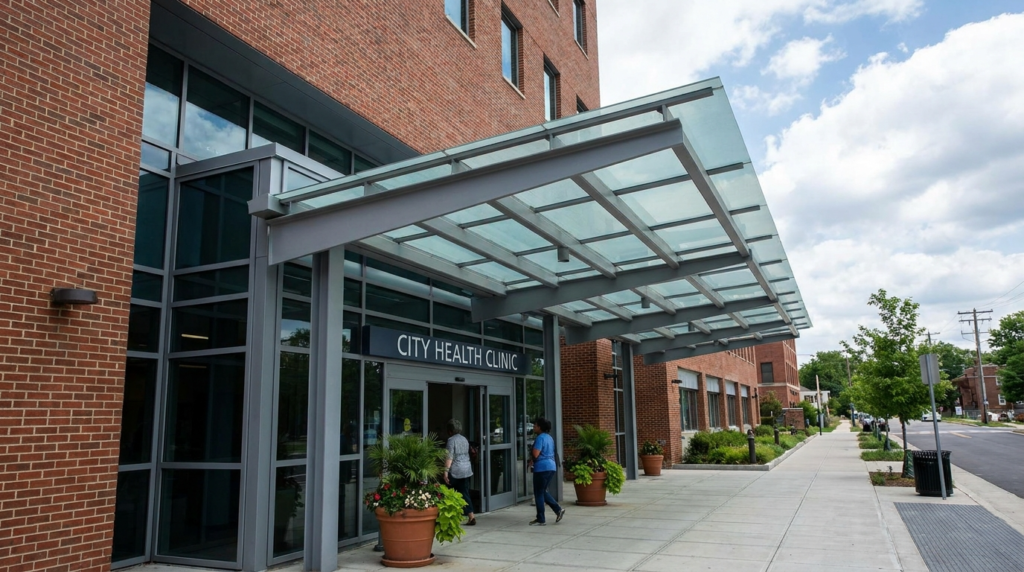
Ottawa canopies for hospitals usually require broader planning than smaller medical properties. A hospital site often has multiple entrances, heavier daily foot traffic, patient and visitor drop-off activity, and exposed outdoor routes that affect how people arrive, move, and wait on the property.
That makes the project less about adding a simple overhead cover and more about improving covered access across the parts of the site that matter most.
Planning around entrances, drop-off zones, and approach routes
Hospitals often need canopy coverage at more than one key access point. Main entrances, patient-facing doors, visitor drop-off areas, and frequently used outdoor approaches can all influence the project scope.
If the need extends beyond one doorway, compare Ottawa entrance canopies with Ottawa walkway canopies to determine whether the project is mainly entry-focused or route-focused.
Supporting daily movement across a larger medical property
Hospitals have more complex movement patterns than many other buildings. Patients, visitors, staff, and service traffic may all pass through the same exposed areas, which means the canopy should support how the site actually functions day to day.
In many cases, the strongest solution is the one that improves the most-used outdoor access points rather than the one that simply covers the most visible entrance.
Building fit, durability, and institutional presentation
A hospital canopy should feel durable, orderly, and appropriate to the scale of the property. It should fit the building and site circulation cleanly instead of feeling like a small add-on that does not belong to the larger institutional setting.
That is why many hospital buyers also compare their options against broader Ottawa commercial canopies when evaluating structure, finish, and site fit.
When a hospital canopy need overlaps with a clinic-style project
Some hospital access issues are more limited in scope and look closer to a clinic project, especially when the problem centers on one patient-facing entrance. The difference is that hospital sites more often involve higher daily traffic, longer access routes, and more pressure to make the solution fit a larger institutional property.
If the need is centered on a smaller outpatient, specialty, or medical office setting, compare Ottawa canopies for clinics.
Request a hospital canopy quote in Ottawa
To scope a hospital canopy project properly, send photos of the entrances, drop-off zones, and outdoor access routes that create the most weather exposure or circulation problems. That makes it easier to determine whether the property needs one major entrance canopy, a covered walkway solution, or a broader access plan.
If the strongest need is tied to recurring pedestrian movement across the site, start by reviewing Ottawa walkway canopies.
Frequently asked questions
Where do hospitals most often need canopy coverage?
Hospitals most often need canopy coverage at main entrances, patient and visitor drop-off areas, emergency-facing approaches, and exposed outdoor routes that are used heavily throughout the day.
Do hospital canopy projects usually include walkway planning as well as entrance coverage?
Yes. Many hospital properties need more than a single entrance canopy because patients, visitors, and staff move through multiple exposed access points and approach routes.
What matters most on a hospital canopy project?
The canopy should improve meaningful weather protection, support the way people actually move through the site, and fit the scale and appearance of a larger institutional property.
Can a hospital start with one priority area first?
Yes. Many hospital properties phase the work by starting with the highest-priority entrance, drop-off zone, or access route, then expanding later if more coverage is needed.